The digital landscape is undergoing a massive shift, and at the center of this evolution is the groundbreaking capability to turn flat, two-dimensional images into fully realized, three-dimensional assets. Leading this charge is Image to 3D AI, a cutting-edge platform designed to democratize 3D content creation. For decades, building 3D assets required specialized technical skills, expensive software, and countless hours of meticulous vertex manipulation. Today, Image to 3D AI bypasses these traditional bottlenecks, allowing creators, engineers, and marketers to generate high-quality assets in a fraction of the time.
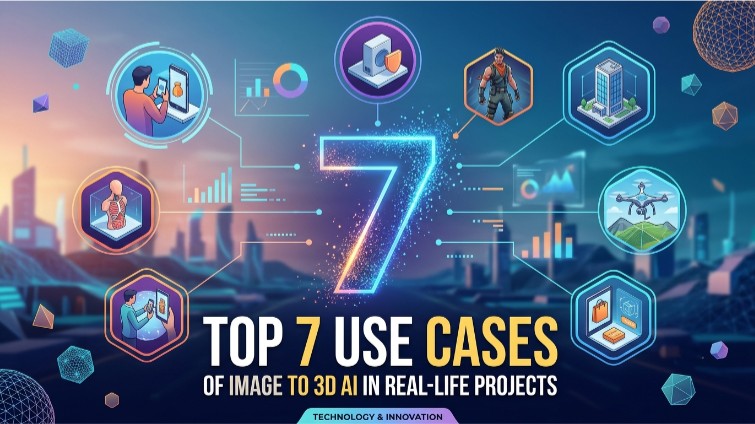
By leveraging advanced machine learning algorithms, this technology analyzes depth, textures, and geometry from a single photograph or prompt to output ready-to-use models. As industries look for faster, more cost-effective ways to scale their digital pipelines, the adoption of image to 3D model ai workflows has shifted from an experimental luxury to an operational necessity. Below, we explore the top seven real-life use cases where this innovative tool is making a tangible, transformative impact.
1. E-Commerce and Interactive 3D Product Visualizations
The retail industry has reached a tipping point where flat images are no longer enough to satisfy modern consumers. Online shoppers want to inspect products from every angle before hitting the “buy” button. Historically, creating a 3D catalog meant shipping physical inventory to a specialized photo studio for expensive 3D scanning or hiring artists to model every item from scratch.
With image to 3D model ai pipelines, e-commerce brands can simply take existing high-resolution studio photographs of their inventory and convert them directly into interactive 3D web assets.
- Reduced Returns: Shoppers get an authentic sense of scale, texture, and form, leading to more confident purchasing decisions.
- Rapid Deployment: Instead of waiting weeks for a design studio, merchants can update their online storefronts with interactive assets in minutes.
- Virtual Try-Ons: Footwear and apparel brands feed their flat designs into the AI engine to generate assets compatible with augmented reality (AR) try-on applications, bridging the gap between physical and digital storefronts.
2. Video Game Development and Rapid Asset Prototyping
Independent game studios and AAA giants alike are constantly battling the “content monster”—the insatiable demand for thousands of unique environment assets, props, and background characters. Asset creation is traditionally one of the most resource-intensive phases of game production.
Game designers are now utilizing Image to 3D AI to radically accelerate their concept-to-engine pipeline. During the pre-production and prototyping phases, concept artists draw a weapon, vehicle, or creature in 2D. Instead of handing that drawing off to a modeling team for a two-week turnaround, the team runs the artwork through the AI generator.
The resulting digital asset serves as an immediate gray-box prototype that can be dropped directly into engines like Unreal Engine 5 or Unity. This enables developers to test spatial dimensions, lighting interaction, and gameplay mechanics instantaneously, saving human artistry for the final, polished hero assets.
3. Real Estate Marketing and Interior Design Virtual Staging
In real estate, selling a property that is either unbuilt or completely empty is incredibly challenging. Traditional virtual staging requires interior designers to manually place digital furniture into photos, a process that lacks true spatial depth and limits the buyer’s perspective to a single static angle.
By integrating an image to 3D model AI solution, real estate platforms and interior designers can take snapshots of real-world furniture pieces, decor, or architectural elements and instantly turn them into assets. These models are then deployed in immersive, 360-degree virtual walkthroughs. Potential buyers can interactively swap out a mid-century modern sofa for a contemporary sectional, exploring how different physical layouts look inside a digital twin of the property.
4. Architectural Concepts and Urban Planning Layouts
Architects frequently need to pitch conceptual designs to clients, stakeholders, and city planning committees who struggle to read traditional blue-line 2D blueprints. Building physical architectural foam models is an aging art form, and rendering full-scale digital environments from scratch for an initial pitch can destroy a boutique firm’s profit margins.
Using Image to 3D AI, architects can take schematic sketches, hand-drawn elevations, or site photographs and generate foundational 3D structures. When trying to show how a new building fits into an existing city block, teams can take drone photography of the surrounding neighborhood, convert those buildings into localized digital assets using the AI engine, and drop their new design seamlessly into a highly accurate digital replica of the urban environment.
5. Hollywood VFX and Pre-Visualization (Pre-vis)
The film and television industry relies heavily on pre-visualization (pre-vis)—a phase where directors map out complex camera movements, stunt choreography, and visual effects sequences before setting foot on a physical stage.
To build these temporary digital sets quickly, VFX departments utilize image to 3D model ai tools. If a script calls for an ancient artifact, a specific vintage vehicle, or a complex sci-fi corridor, the pre-vis team doesn’t need to spend critical budget on high-fidelity modeling early on. They can scrape reference imagery or use production mood boards to generate the geometry needed to block out the scene, allowing the director to find the perfect camera angles and lighting setups well ahead of principal photography.
6. Historical Preservation and Museum Digitization
Countless historical artifacts, ancient sculptures, and fragile archeological findings are locked away in museum vaults, inaccessible to global researchers and the general public due to their delicate physical states. While traditional photogrammetry (stitching hundreds of photos together) is highly accurate, it requires specialized, controlled lighting rigs and massive computational power.
Image to 3D AI provides an accessible alternative for cultural institutions. Archival departments can take historical photographs, even archival images from mid-20th-century excavations, and reconstruct a lost asset’s geometry. This allows museums to build open-access digital archives where students and historians worldwide can rotate, inspect, and analyze artifacts through a web browser, preserving human heritage against physical decay and natural disasters.
7. Custom Augmented Reality (AR) Marketing Campaigns
Social media platforms have turned augmented reality into a massive playground for brand engagement. Millions of users interact daily with AR face filters, world lenses, and interactive ad campaigns. However, local brands and creative agencies are often locked out of this space due to the overhead costs of 3D asset production.
With Image to 3D AI, agencies can take a client’s 2D brand mascot, product packaging, or logo and instantly generate an optimized, low-polygon 3D model perfectly tailored for mobile AR lenses. This democratization allows agile marketing teams to launch hyper-localized, interactive campaigns within days of a trending cultural moment, drastically increasing consumer engagement metrics.
Embracing the Future of Spatial Content
The transition from flat screens to spatial computing is accelerating. As virtual reality headsets, AR glasses, and web3 frameworks integrate further into daily workflows, the world will require an unprecedented volume of three-dimensional assets to fill these digital spaces. Human creators alone cannot keep pace with this exponential demand.
The integration of an intelligent image to 3D model AI engine completely changes the economics of digital creation. It transforms the role of the designer from a manual asset builder into a high-level creative director. Instead of spending days worrying about clean polygon flow and topology, creators can focus entirely on style, storytelling, and user experience.
Whether you are an independent game developer looking to build a massive open world, an online retailer trying to boost conversion rates, or an agency looking to launch the next viral augmented reality filter, the tools are ready for you. By implementing Image to 3D AI into your production ecosystem today, you are not just optimizing your current business pipeline—you are future-proofing your creative vision for the spatial web tomorrow.